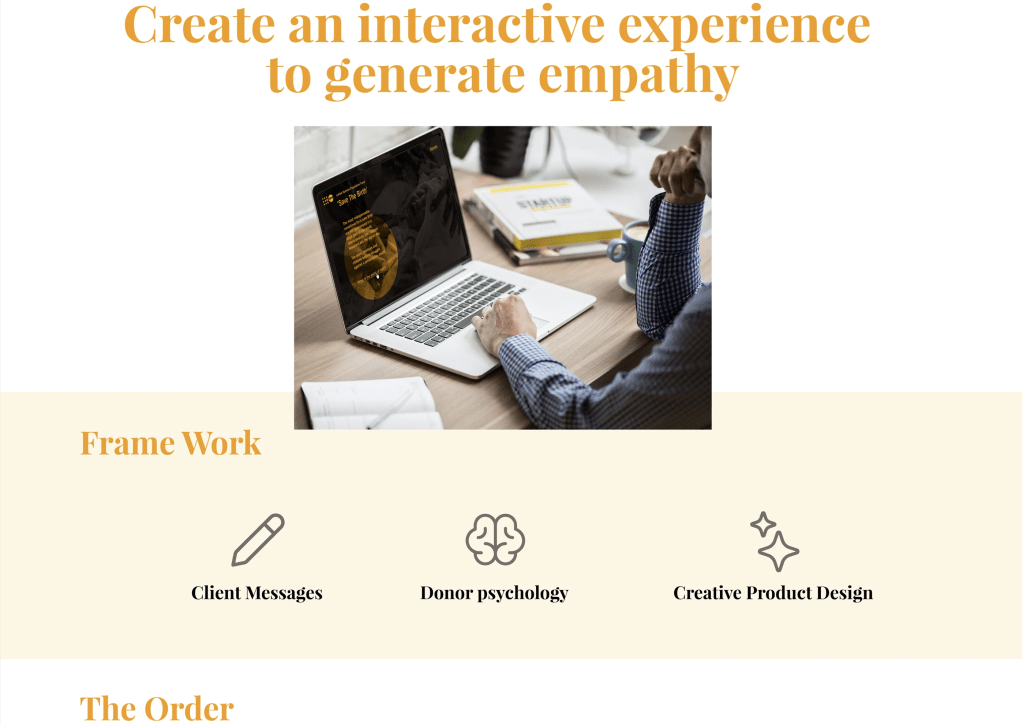
UNFPA is the United Nations sexual and reproductive health agency. Their mission is to deliver a world where every pregnancy is wanted, every childbirth is safe and every young person’s potential is fulfilled.
UNFPA is formally named the United Nations Population Fund.
The organisation asked us for a creative proposal for a website for an awareness-raising campaign to end preventable maternal death. The campaign would be launched on the occasion of Mother’s Day.
For the data, we were provided with all available data on the most vulnerable countries, in extreme poverty and war situation.
The goals:
• Raise awareness and mobilise private sector resources for maternal health interventions in fragile and humanitarian settings.
• Find a way to communicate data in a very agile way and with more emotion than just statistics.
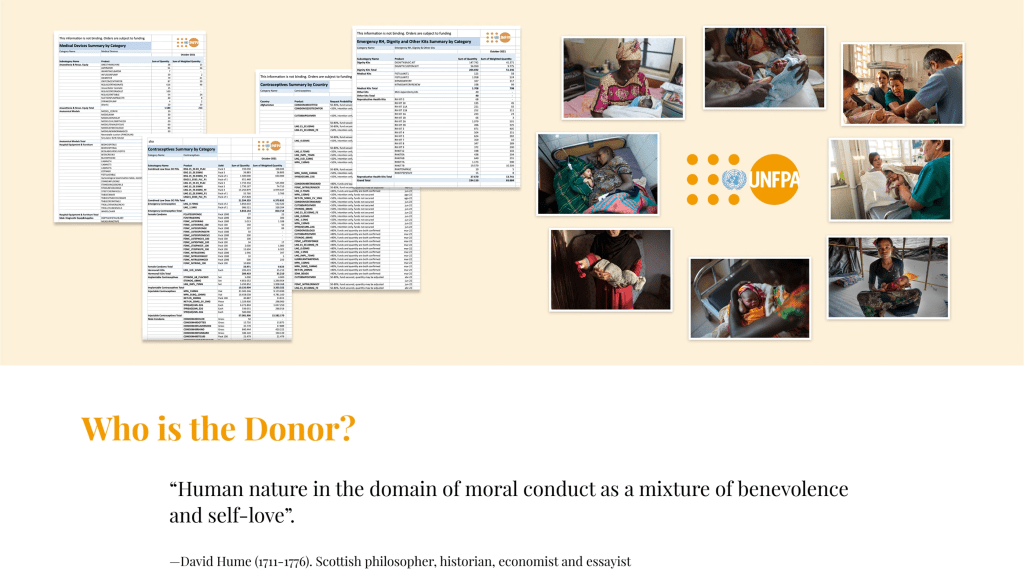

A UN foundation has to be first and foremost universal. All of the agency’s communication must be easy to process by anyone from any culture or country. In no case can it contain segregation bias, paternalism or social / cultural prejudices or other type of exclusion. That is why it would not be very useful to create a User Persona in such a case. Or we should create millions of them.
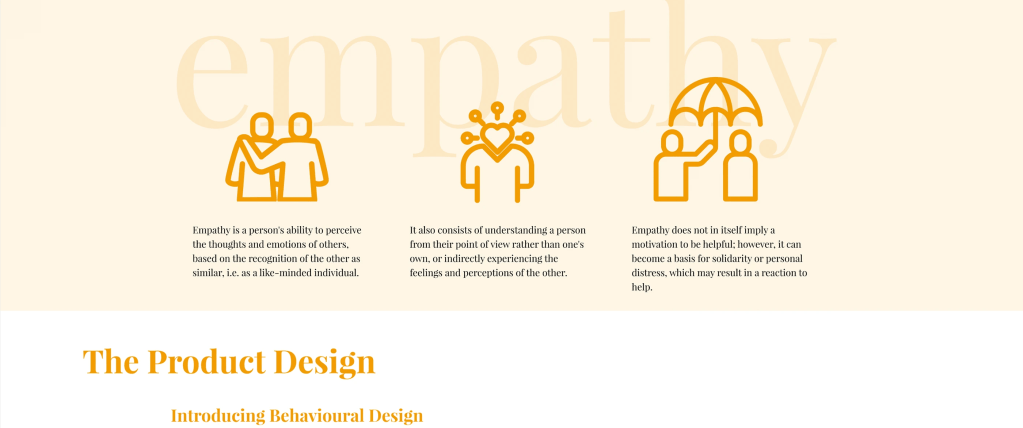
Therefore, it is more effective to focus on the universal quality that we need to join the cause and that we want to stimulate with our user experience: empathy.
In order to work with or influence human behaviour and decision-making, it is of utmost importance that we focus our efforts on understanding the depth of people’s psychology and cognitive processes, especially while designing solutions for products, services and public strategies.
In fact, the practice of integrating psychology into the solution design process has become so important in areas such as business and public policy design that, since the last 25 years, its professionalisation has been strongly encouraged in the public, private and academic spheres.
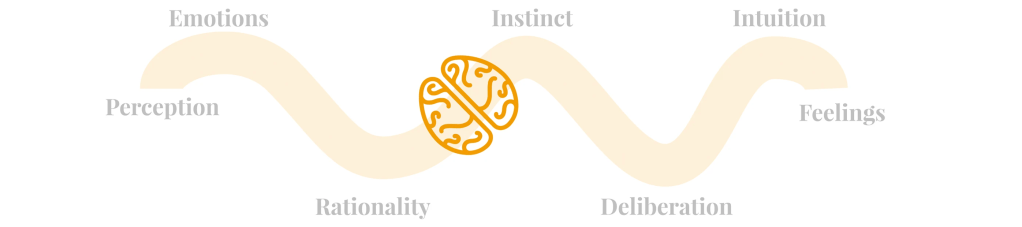
In the 1970s, Kahneman and Tversky studied how people actually make decisions. They defined our brain function and behaviour as System 1 and System 2.
— System 1: the fast one —
System 1 is emotional, instinctive, intuitive, associative and has adapted to make quick decisions trained in habit by using mental shortcuts or heuristics to ease the cognitive load and save the brain time and energy.
System 1 is powerful enough to have helped humans survive for millennia, and it is still with us today: it receives and sorts sensory data, decodes and decides what is worth getting excited about and what is not. Most of that happens at a pre-conscious level, as an emotion, before it reaches our conscious mind as a feeling.
— System 2: the slow one—
System 2 is rational, slow and deliberative, and often lazy; it is happy to let System 1 do most of the work. System 1 is street smart and System 2 is reading smart.
How do we make decisions?
Most often our decision making and actions are driven by all the feelings of System 1. This is not a new revelation to marketers and anyone else interested in human nature.
If we were to make decisions with System 2, they would be entirely rational through deep user deliberation over the full set of cold, hard facts and practical, realistic logic. Which is a much slower process and requires much more effort.
Cognitive biases are a kind of ongoing cognitive ‘condition’–tendencies to selectively search for and interpret data in a way that confirms one’s existing beliefs. A cognitive bias is an inherent thinking ‘blind spot’ that reduces thinking accuracy and results arbitrary conclusions.
THE COGNITIVE BIAS CODEX
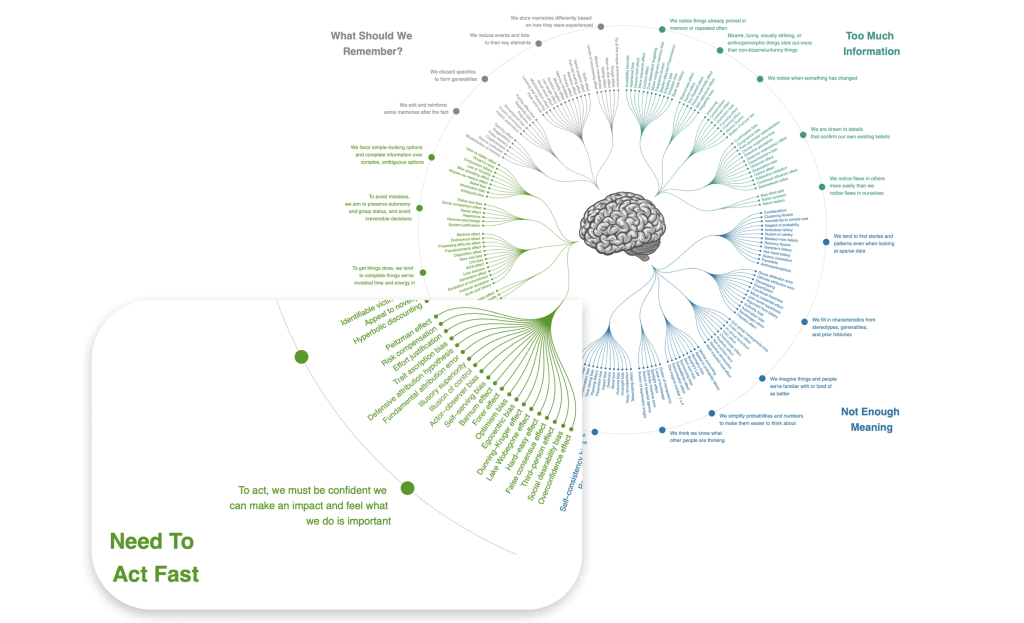
Categories and descriptions originally by Buster Benson.

We’ve gotten pretty good at being able to subconsciously influence and alter behavior (by nudging, for one), which creates a vexing ethical conundrum for UX designers. The UX professional must understand that for every product created with the “best intention,” there will be another that deliberately nudges the user to ends not in the user’s best interest. Thus on the one hand, they recognize that human behavior often results in sub-optimum choices and actions. On the other hand, they recognize that they have the potential, through design, to affect that behavior in other ways — positive and negative.
So how do UX professionals define their ethical responsibilities as they subconsciously influence users’ decisions or actions? The case of producing negative outcomes is clear; less clear is who determines what is “positive.”
To frame the problem quickly, asking for donations raises very delicate ethical questions that lie somewhere between beneficence and solidarity, charity (which needs to be very well defined to avoid negative connotations) and certain paternalism (which is no longer so positive).
It is therefore a great challenge to guide the user to make the decision to donate for good reasons. Moreover, it has to be said that the reputation of the Foundation is at stake. And it is not so easy to find the right point.

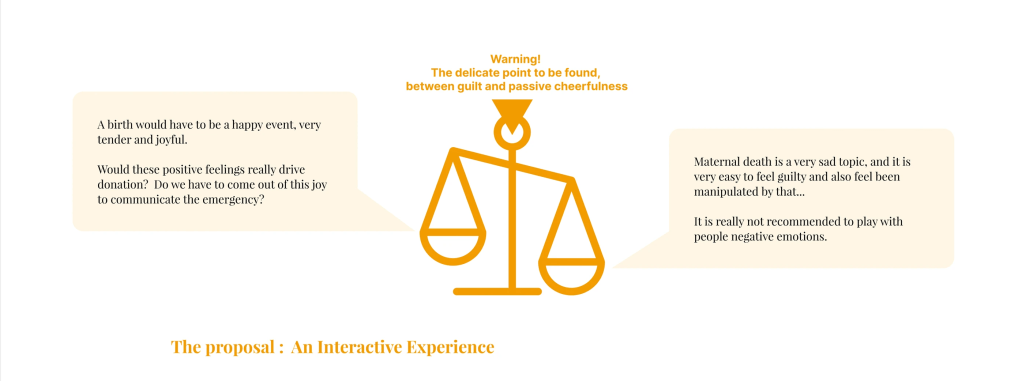
Just as we decided that empathy would be the most important character trait of our user persona, here we state for the ethical plane that we wish to stimulate feelings of friendship and a certain sense of beneficience duty to promote equality and justice.
That is why we decided to have a tone of truthfulness in our communication with the user, more like journalistic information, objective, direct and neutral. And avoiding the intention of persuasion, we try to create an atmosphere of trust and honesty, very similar to that of a friendly relationship.
‘SAVE THE BIRTH’, the best name for the campaign
The name «SAVE THE BIRTH» suggests that there is something to be done to improve the problem of maternal death. It’s an invitation to act fast. Everyone can help. It is something that is within reach.
And this action perspective is perfect for our interactive experience.
– How much time do we have to capture our user’s attention?
1-2-3-4-5. The time it takes to recite these five numbers aloud is the average amount of time people spend in sustained attention to a new message, news article, photograph, video or conversation. During that instant, if the user’s attention has not been captured, he or she has already gone…
– The value of the interactive experience
By simulating an experience through interaction, in which the user discovers the problem, we are able to create emotional empathy, which is the fundamental ingredient of communication and partnership.
This experience is created as a broad idiosyncrasy, a kind of synchronisation between ethics, aesthetics, communication and one’s own feelings and thoughts.
This emotional empathy is what we want to stimulate, as it is a good way to convince the donor to make a financial contribution. It is based on a friendly and healing feeling for the cause, for the people and for the world.
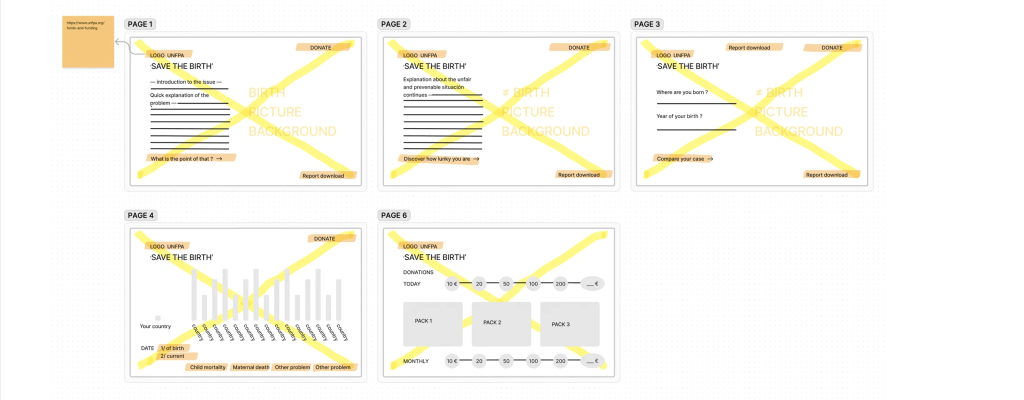
THE USER INTERACTION
The proposal for our website is the opposite of being a mere passive information medium.
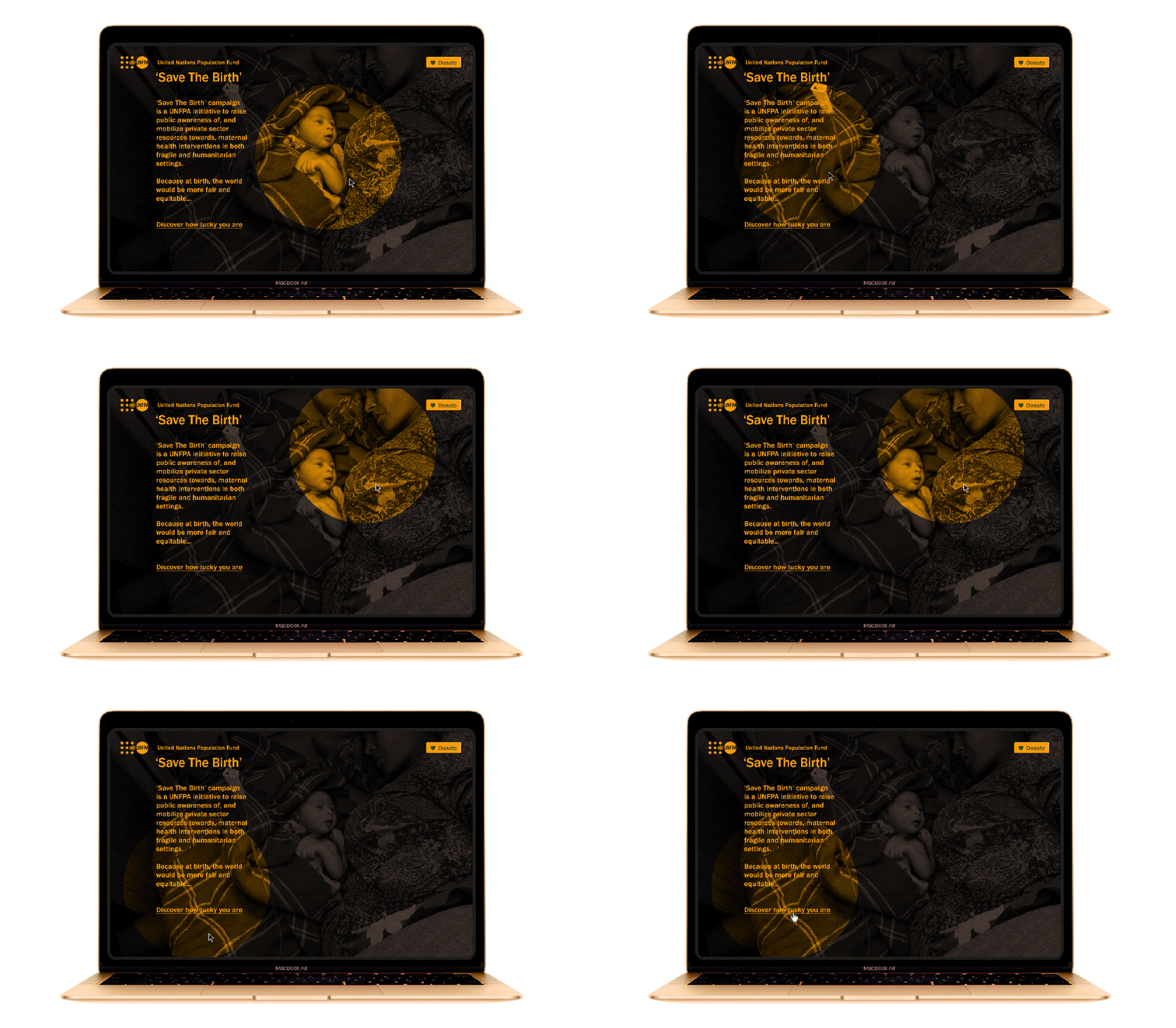
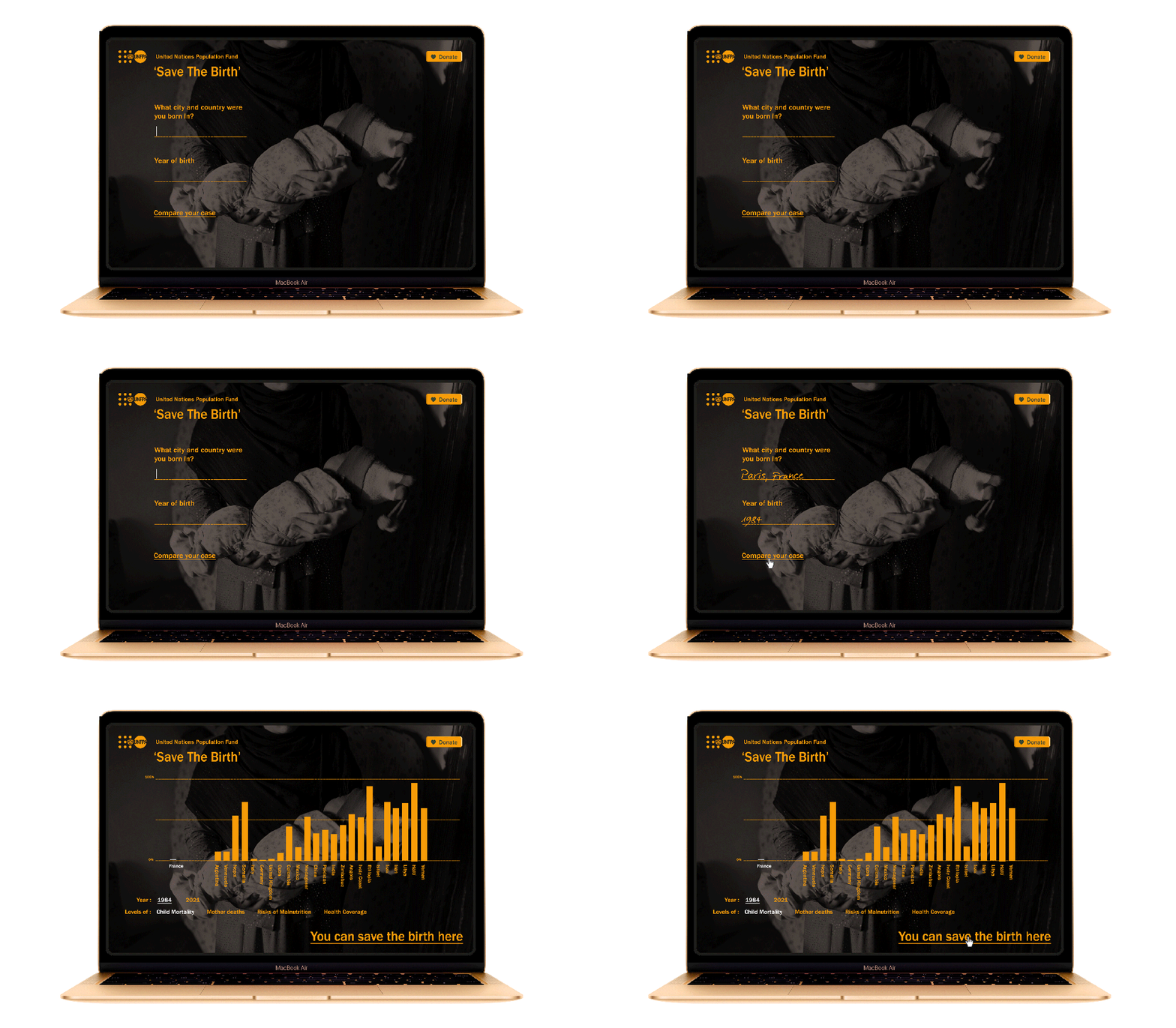
The user needs to direct the mouse, linked to the lighting point, to discover the picture and the issue of the campaign. Totally interactive from the beginning.
Also, every screen of the app have the right quantity of data to be processed without very much effort (for brain system 1), giving the sensation that the decision required is not only impulsive, but also rational and above all voluntary.
Interaction elements:
– A graphic composition with a circle as a point or a focus.
– This point is also a graphic item related to UNFPA brand.
– The user can play moving it with the cursor to discover the birth picture underneath…
It is a subtle way of saying that many times the problem is hidden and also an invitation to discover it.
The aim of the experience is to put our own reality in comparison with others that are much more precarious. This strategy appeals to a sense of equality, justice and solidarity (or friendship). In addition, it allows a lot of data to be presented in a lighter and more didactic way so that it can be processed easily.
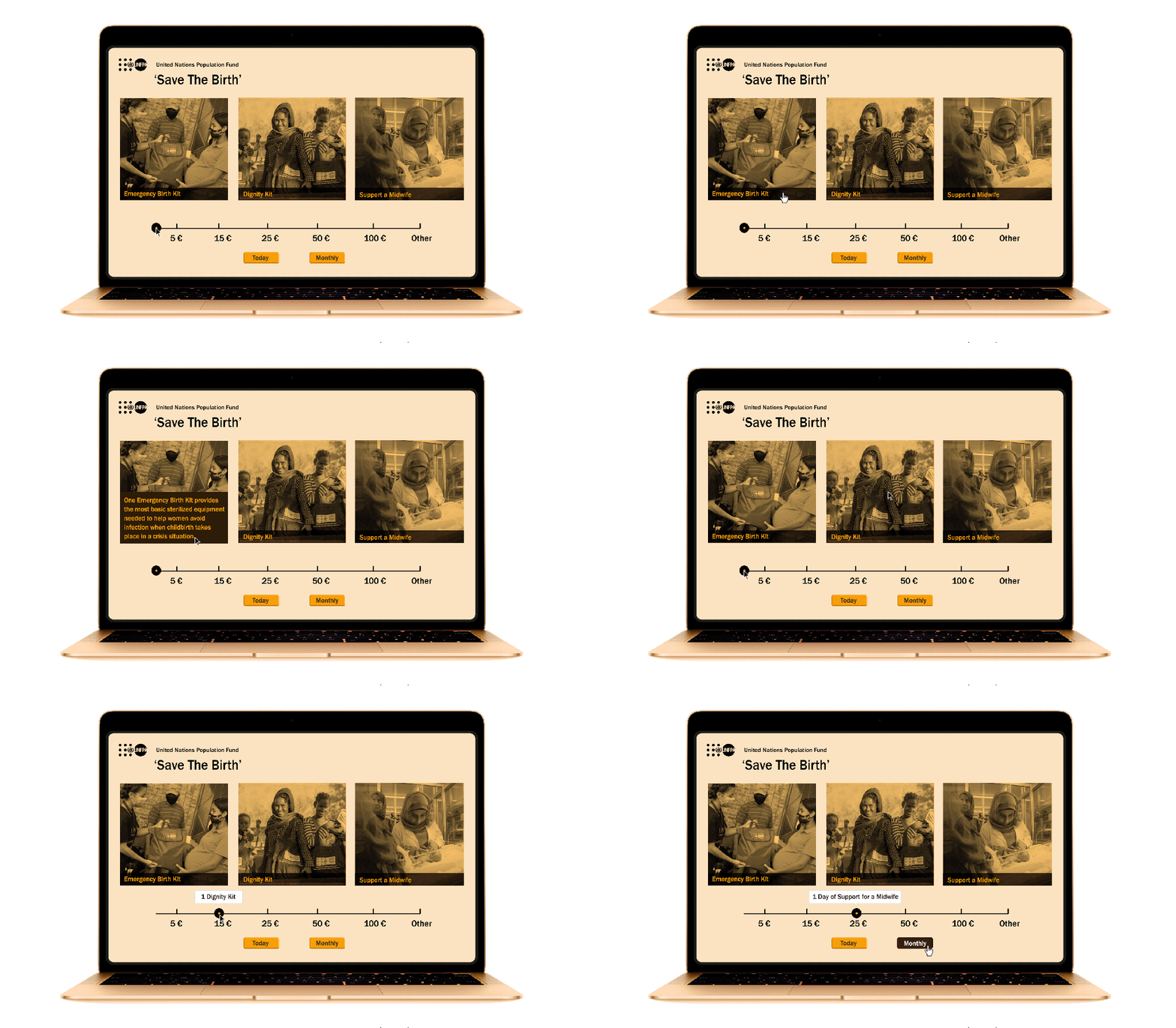
Finally, the donation formula associated with specific objects is also very effective because it convinces of the usefulness of the donation and gives the donor a greater sense of satisfaction.
The prototype:

>>> THANK YOU FOR HAVING READ THIS : )
marieobelleiro@gmail.com
M. +34 677 30 20 18
← Back to www.marieobelleiro.com
 Marie Obelleiro